
The Deferral Engine
How Dropbox spent five years shipping features while quietly pushing its core value further away from every new user who came through the door.

Product Strategy • Growth • Onboarding • Dropbox • The Deferral Engine • SaaS
The Number I was looking at…
The VP finished the slide and looked up at the room.
Revenue was up. The number on the screen was green, large, the kind of percentage that makes a boardroom exhale. Client growth was on the next slide. I remember watching it come up and doing the arithmetic quietly — the revenue line and the client line were moving in different directions. Revenue growing. Client count flat.
Nobody asked about it. The meeting moved on.
I didn’t say anything either. I’m not sure what I would have said. The number was technically good. It just wasn’t the number I was looking at.
The Grammar of Growth
There’s a particular grammar that develops in product organizations around growth. It has its own vocabulary — activation rates, top-of-funnel efficiency, acquisition velocity — and its own aesthetic: upward lines, green numbers, percentage deltas that survive a boardroom. The vocabulary is precise enough to feel rigorous. The aesthetic is legible enough to get the slide through.
What it rarely surfaces is the question underneath: where is the revenue actually coming from? If client count is flat and revenue is growing, the math resolves one way. You are charging your existing users more.
The growth isn’t growth. It’s extraction.
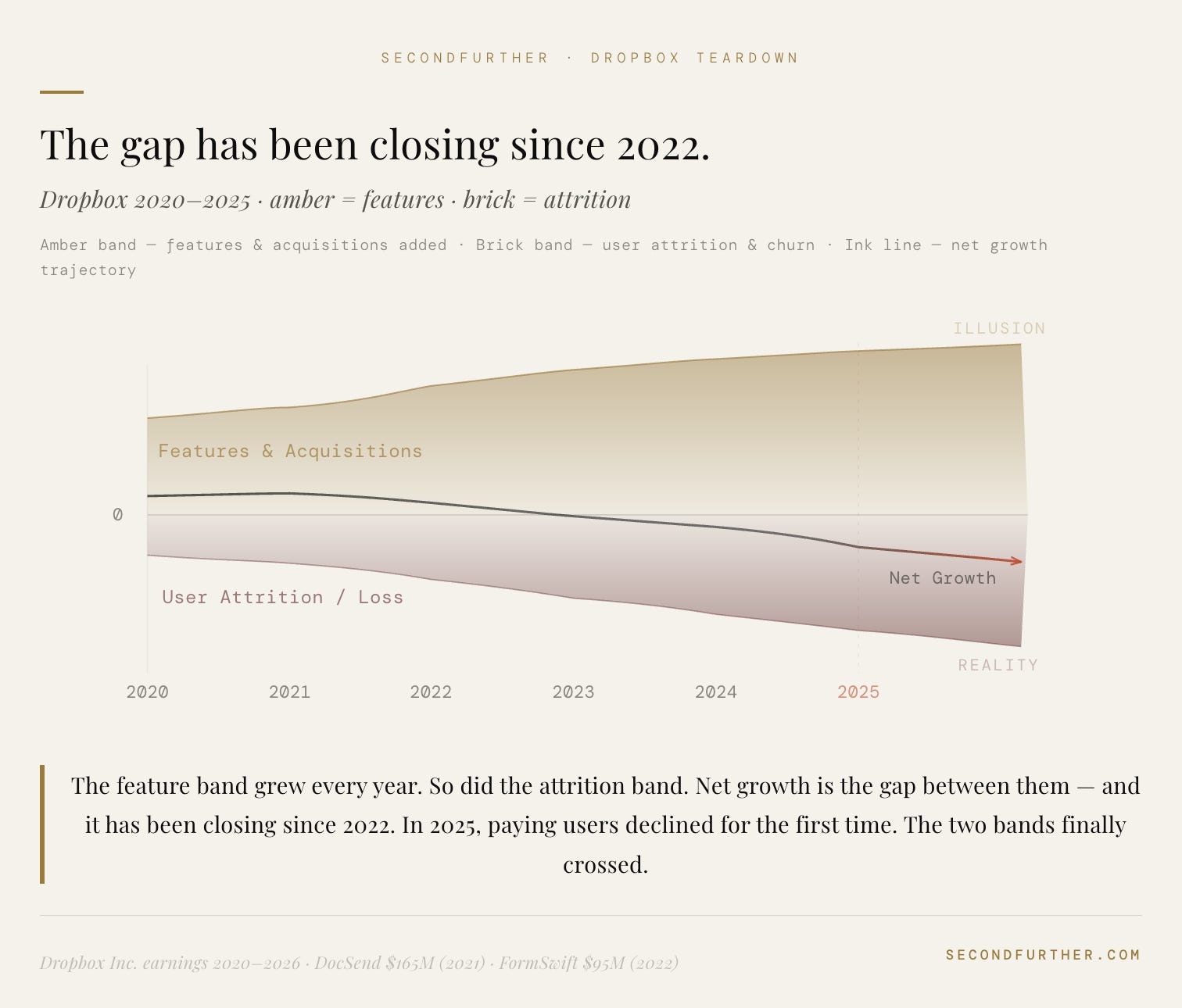
What Dropbox's numbers actually say
Dropbox filed its 2025 results in February. Total revenue was $2.52 billion — down 1.1% year over year, the first annual revenue decline in company history. The number that takes longer to find:
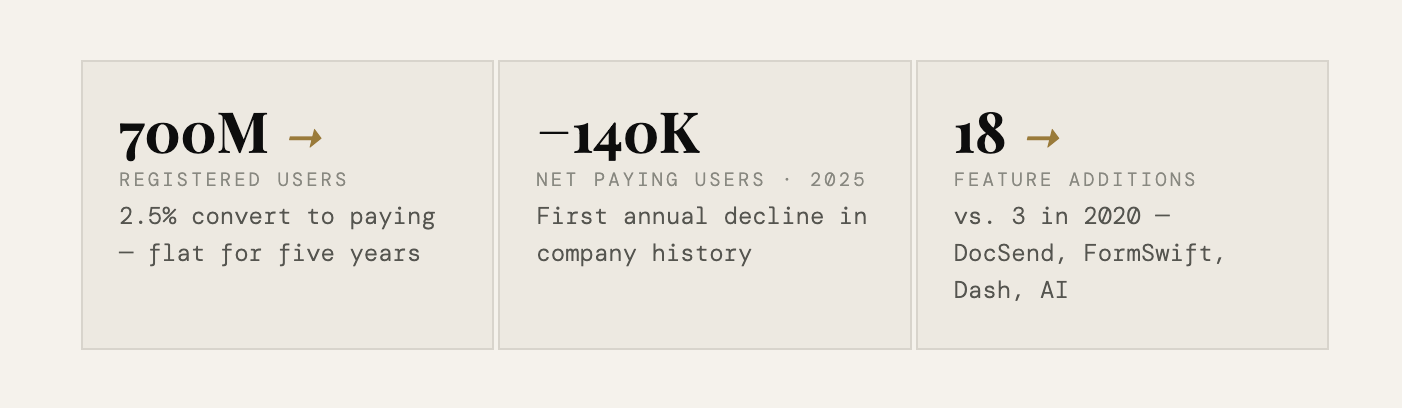
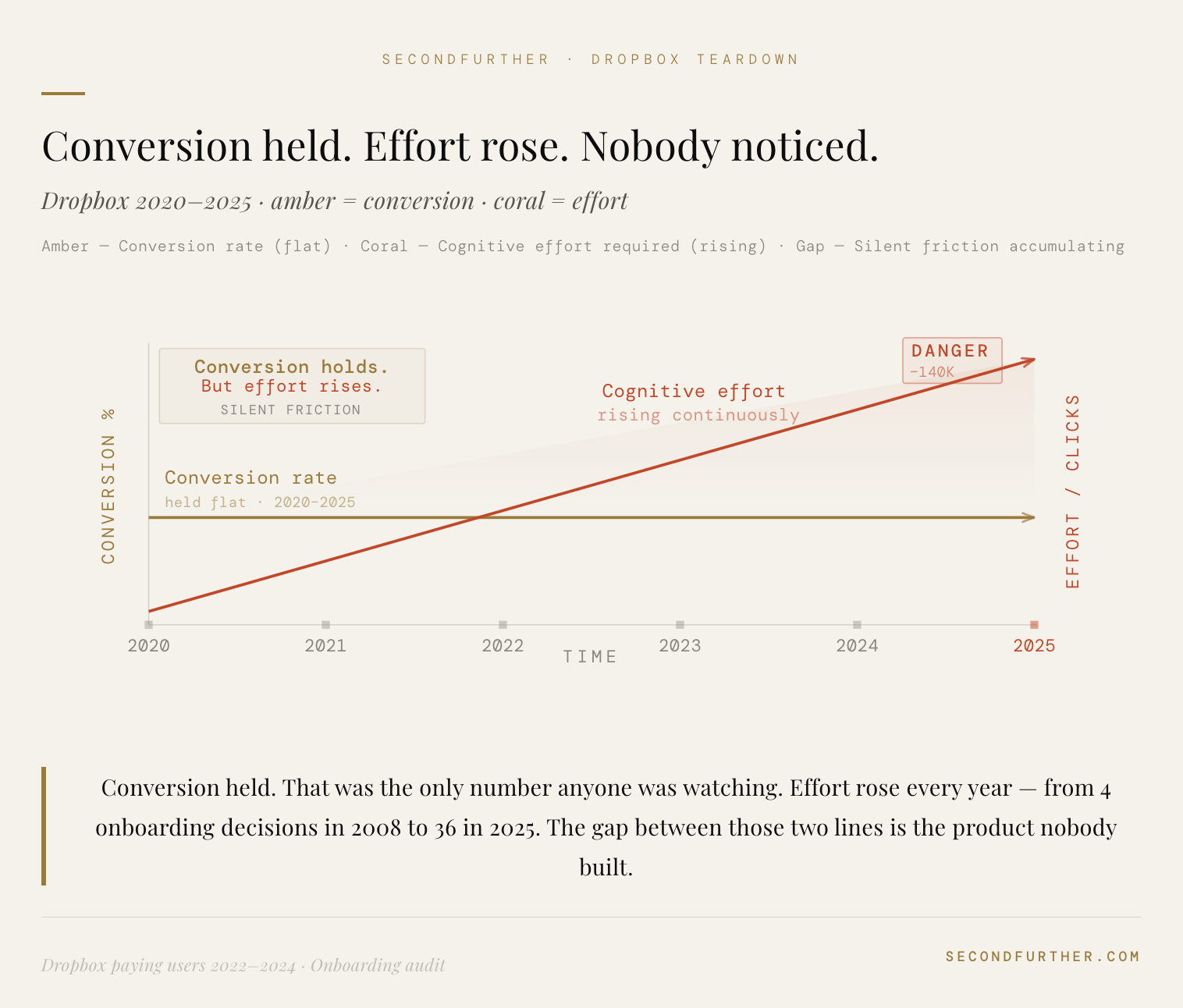
In the same period, the company shipped Dash for Business, continued developing Spaces, integrated FormSwift, and restructured its workforce. The product grew more complex. The conversion rate didn't move.
The Mechanism
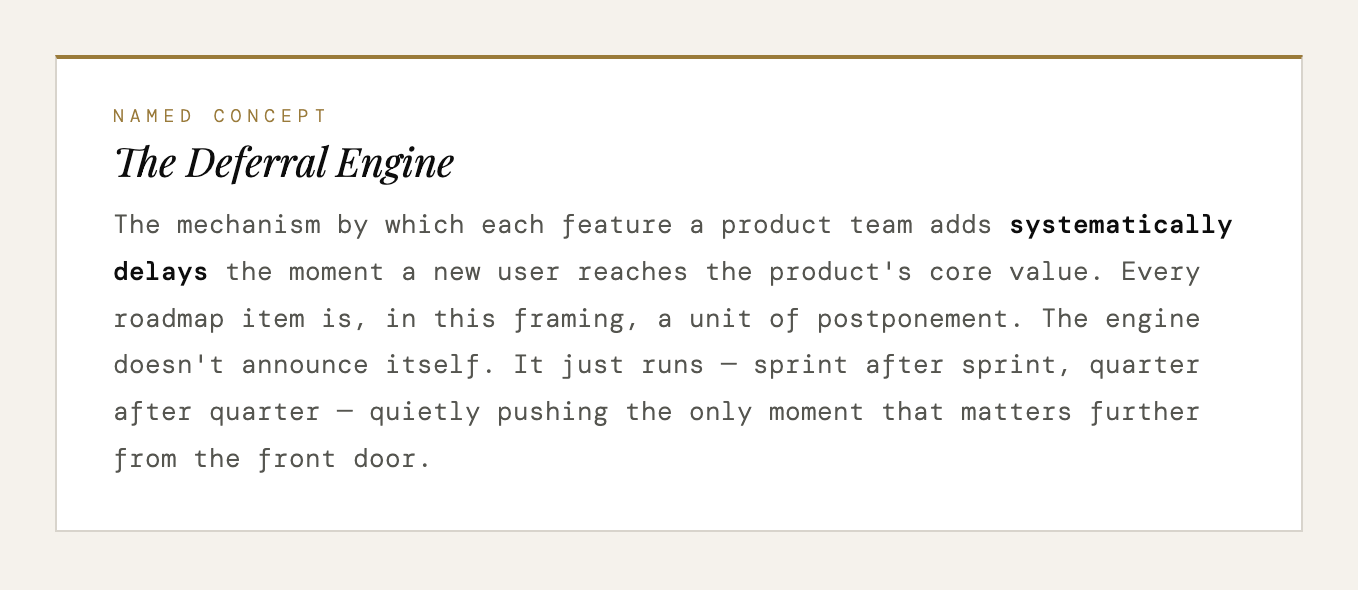
Every product has a moment — sometimes called the AHA moment, if you're inclined to that vocabulary — where its actual value becomes undeniable to the user. That moment is the only thing standing between a new user and a retained one. It has a peculiar property: it doesn't move on its own. The product team moves it.
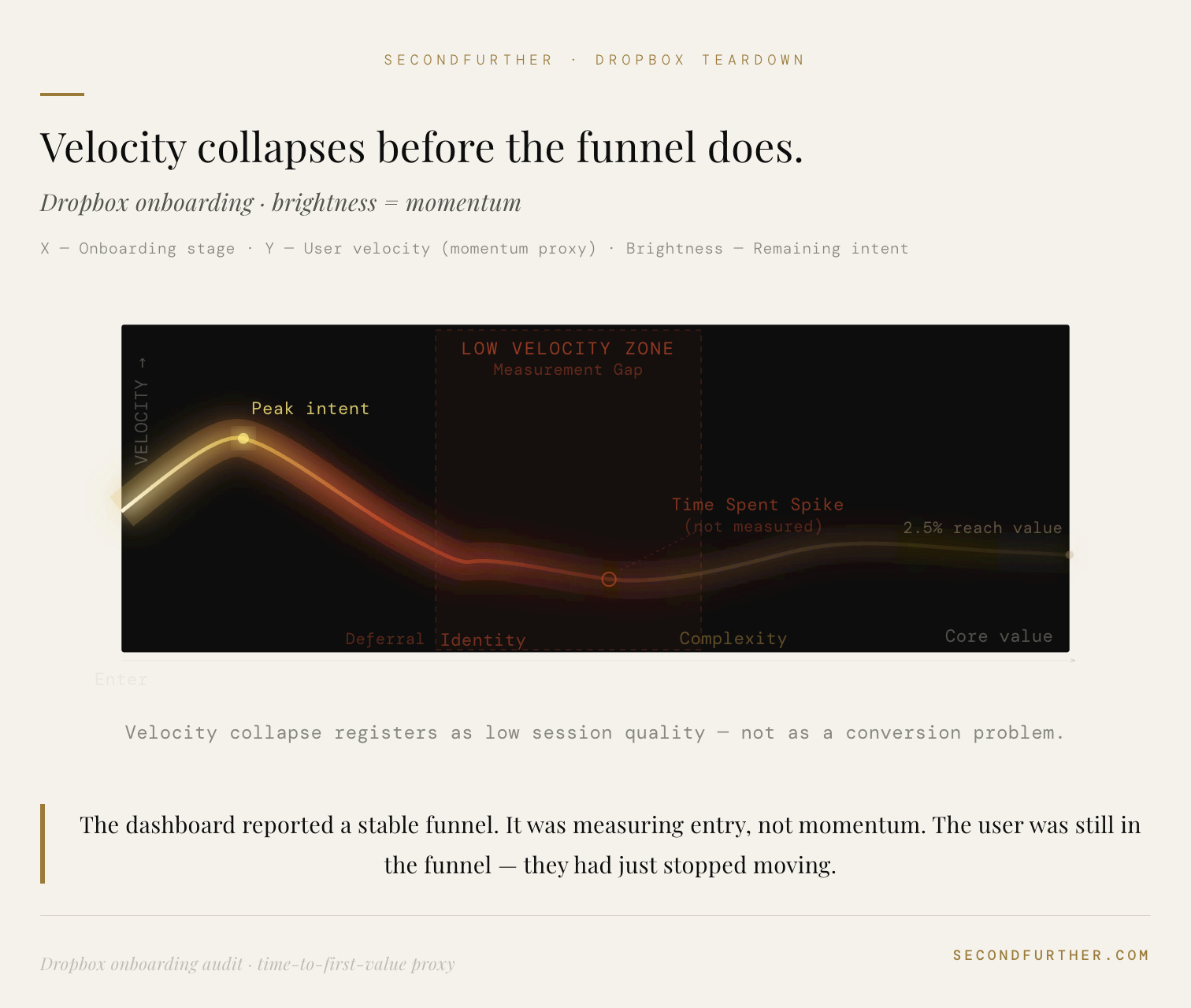
Dropbox’s core value is not complicated. It is: your files, everywhere, without thinking about it.
That proposition was clear in 2008. Somewhere between then and a 700-million-user free tier, the path from sign-up to that moment got longer.
The Deferral Engine is not the result of bad decisions. It’s the result of good decisions made inside a system where the incentive to add is structural and the incentive to subtract is not built in anywhere. Features have owners, OKRs attached, launch plans, metrics tied to someone’s performance review. Subtraction has none of these things. Removing a feature is, organisationally speaking, a thing that happens to no one.
And so the product grows in one direction.
The Asymmetry
Here is a hypothetical - not a prescription, because I don’t have access to Dropbox’s conversion data, their onboarding funnels, or the internal reasoning behind any of it. But if the Deferral Engine diagnosis is correct, the treatment looks something like this:
Stop measuring what registered users do. Start measuring the gap between registration and the first moment a user stores something they actually needed - not a test file, not an onboarding prompt, but a real thing they would have lost otherwise. That gap, in days and in friction, is the Deferral Engine made visible. Then work backwards from it. Not by adding a better onboarding flow. By removing everything between sign-up and that moment that didn’t need to be there.
The 700 million registered users are not a distribution problem. They are a conversion problem. The product already reached them. Something between the front door and the core value is sending them back out.
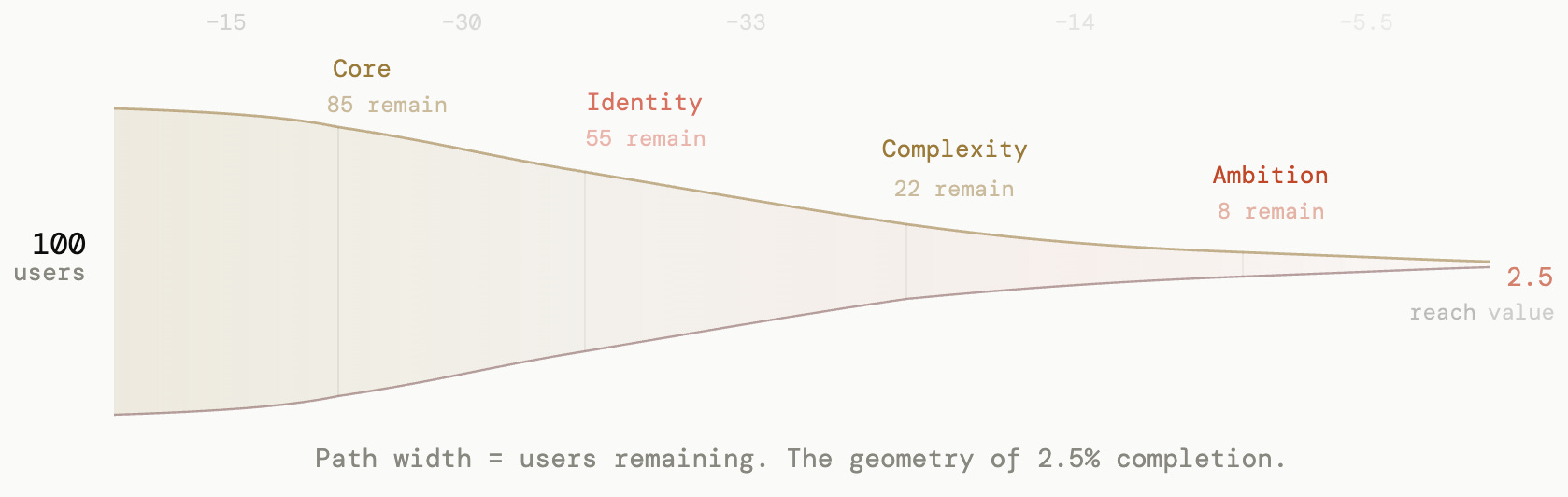
A hypothetical, not a prescription
I’ve started asking a different question in planning sessions:
If you removed the three features your team shipped in the last two quarters, would the product be better or worse for the user who almost stayed?
The silence is usually informative.
I don’t have a clean answer to what a growth function that rewards subtraction looks like inside a real organisation. I’ve seen teams try. Most of it doesn’t survive contact with the next planning cycle.
What I keep returning to is the image of that boardroom. The green number on the screen. The client count on the next slide, quiet and flat.
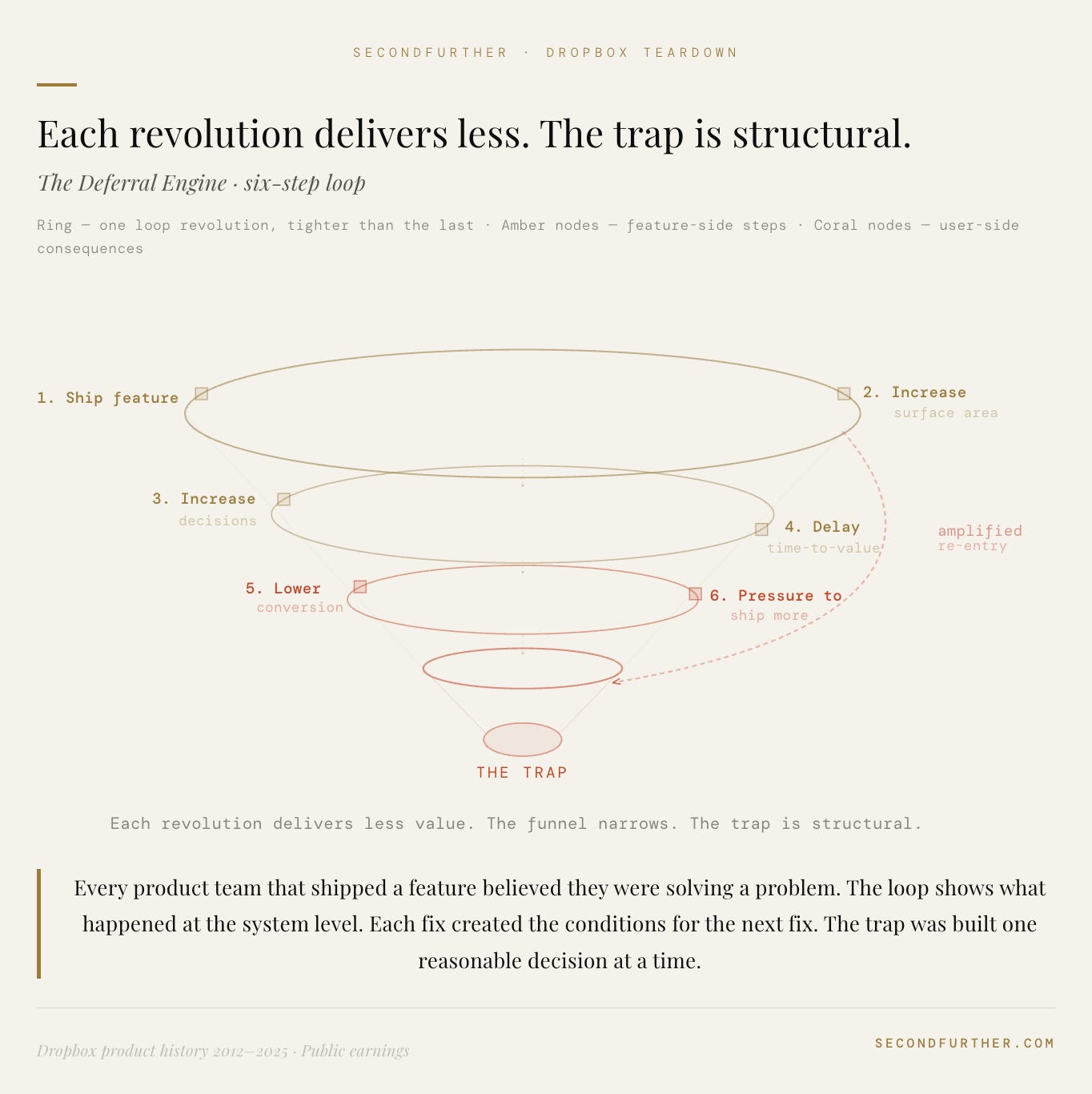
The 700 million registered users are not waiting to be converted. They are waiting to feel the thing they signed up for.
The Deferral Engine, running!
Sources: Dropbox Inc. Q4 2025 earnings release · Annual results 2020–2026 · 10-K (February 2026) · UX onboarding audit (Alex Oskie, Dropbox Business, 36-step finding) · secondfurther.substack.com